This season, a club built on the spirit of its supporters will compete in Liga Super, with Kela...

To understand what happened under the blinding floodlights of New Jersey, you must first accept an uncomfortable truth about modern international sport: it is no longer merely a game. It is a multi-billion-dollar traveling circus, wrapped in corporate sponsorship, draped in geopolitics, and delivered to millions through a meticulously scripted narrative. For six long, exhausting weeks across the North American continent, we were invited—indeed, practically required—to believe that Argentina were the preordained protagonists of this grand, manufactured epic. We were meant to marvel at their destiny, applaud their grit, and swoon over the poetic twilight of their talisman.
Yet, as the glitter settled and the artificial hype evaporated into the night air, we were left with a reality so stark, so utterly undeniable, that it shattered the carefully constructed narrative into a thousand pieces. Spain did not just win the World Cup final; they delivered a masterclass in total, clinical demolition that exposed the entire Argentine campaign for what it truly was—a protected journey that ran out of paved road the moment it encountered a genuinely superior machine.
To view Argentina’s march to the final as mere luck of the draw is to ignore the heavy political machinery humming quietly in the background. In an era where soft power and diplomatic posturing dictate global agendas, this tournament was never just about twenty-two men kicking a leather sphere. Argentina found themselves positioned as the ideal ideological poster child for the host nation’s geopolitical ambitions. Culturally aligned with Western alignment strategies, historically positioned as a comfortable bridge between continents, and eager to align with global power centres, Argentina represented a politically safe, commercially lucrative champion.
Contrast this with the uncomfortable friction generating elsewhere on the global stage. As host authorities faced sharp international criticism for their heavy-handed immigration enforcement, controversial diplomatic interventions, and tension with nations across the Global South and Middle East, Argentina provided a sanitised, highly marketable distraction. They were the preferred corporate entity—a global brand led by a global icon, tailored perfectly to reinforce a narrative of Western-centric athletic dominance. The whisperings of institutional favouritism, from suspiciously convenient evening kickoff slots to lenient officiating that ignored tactical cynicism, were not mere paranoia. They were the logical byproduct of a tournament ecosystem desperate for a culturally aligned winner to validate its grand political stagecraft.
Let us be entirely honest about how Argentina reached that stage in the first place. Their path through the expanded, bloated tournament bracket was about as treacherous as navigating a well-maintained hatchback through a suburban supermarket car park on a quiet Sunday morning. While the heavyweight nations on the opposite side of the draw were busy tearing each other to shreds in an absolute bloodbath of high-intensity European and South American clashes, Argentina glided through a cushioned corridor of soft draws and convenient fixtures.
Group stage matches against Jordan and Algeria were little more than warm-up exercises. The knockout rounds brought encounters with Cabo Verde, Egypt, and Switzerland—respectable athletic delegations, to be sure, but hardly the terrifying pantheon of world football. Even against this modest lineup of opposition, Argentina looked inexplicably clunky, relying heavily on a mixture of emotional drama, physical gamesmanship, and refereeing decisions that ranged from the curiously lenient to the outright permissive. They didn’t glide into the final on a wave of majestic footballing superiority; they dragged themselves there, sputtering along, shielded by the bracket and saved by isolated moments of individual salvage work.
Then came the final at MetLife Stadium, and with it, an abrupt collision with absolute reality.
If Argentina’s route to the final was a comfortable, low-speed cruise, meeting Luis de la Fuente’s Spain was the equivalent of driving that comfortable hatchback straight into a speeding freight train. Spain did not merely win a game of football; they operated a high-efficiency industrial shredder. From the very first whistle, the Spanish midfield engine—driven by the relentless, mechanical precision of Rodri, Pedri, and Fabián Ruiz—choked the life out of the pitch. They didn’t just control possession; they systematically starved Argentina of space, time, and oxygen.
Furthermore, Spain’s presence in the final carried its own heavy symbolic weight. With the Spanish government standing as one of the most vocal, unapologetic European critics of global oppression and host-nation foreign policy, La Roja stepped onto the pitch not just as a football team, but as an implicit act of defiance. They were the unscripted spanner in the corporate works.
The statistical reality of Argentina’s performance in regulation time was not merely poor; it was historically impotent. Zero shots on target across ninety minutes of play. A grand total of 0.00 expected goals. One single, solitary touch inside the Spanish penalty box for an entire match. Read those numbers again and let them sink in. This was not a tactical misstep or a bad day at the office. It was a complete, structural breakdown.
All the romantic chatter about Lionel Messi bending the laws of physics one last time was flushed down the drain within twenty minutes. The great man was rendered completely redundant, wandering around the centre circle like a man who had misplaced his car keys in a crowded shopping mall. Isolated, starved of service, and completely suffocated by Spain’s counter-press, he became a quiet spectator to his own team’s undoing.
When a team realises that its tactical setup is fundamentally useless against a superior opponent, frustration inevitably takes over. The physical cynicism and aggressive pressing that had gone largely unpunished against weaker sides earlier in the tournament finally met a referee unwilling to indulge the theatrics. The dark arts failed. The persistent fouling yielded cards rather than momentum, culminating in the inevitable red card for Enzo Fernández as stoppage time ticked away. By the time extra time rolled around, Argentina were reduced to ten men, defensively besieged, and relying entirely on the desperate, heroic reflex saves of Emiliano Martínez just to keep the scoreline from becoming an absolute farce.
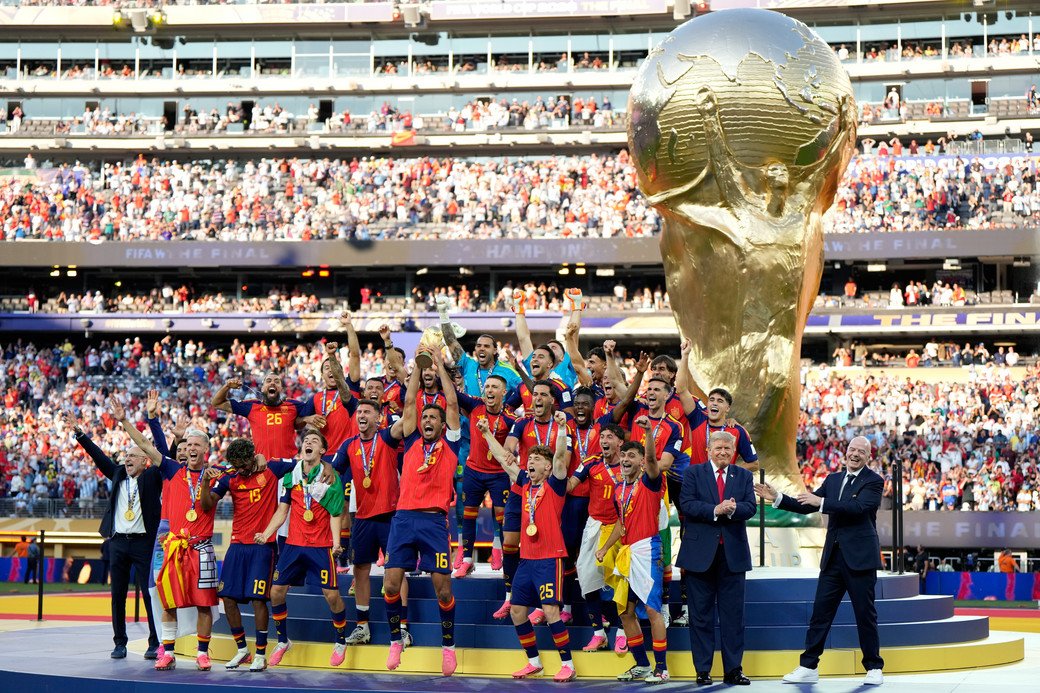
When Ferran Torres finally smashed his extra-time volley into the top corner in the 106th minute, it felt less like a dramatic climax and more like the enforcement of an inevitable natural law. Spain had conceded just one single goal across the entire tournament, setting a defensive record that will likely stand for decades. They played pure, unadulterated, precision-engineered football, completely devoid of cynicism or reliance on favourable draws.
For weeks, organisers had built a global stage meant to showcase a pre-packaged result designed to satisfy broad commercial interests and political posturing. But football, in its purest moments, possesses a wonderful, stubborn refusal to follow a script written in diplomatic suites. You can construct the easiest draw in modern history. You can assign the most convenient kickoff times. You can align political motivations and hope for lenient whistles. But you cannot fake performance when twenty-two men step out onto the grass against an elite, unyielding machine.
Spain’s victory was not just a win for a magnificent football team; it was a victory for sporting integrity over manufactured spectacle and political theatre. It proved that while a favourable path and political backing can carry a team to the doorstep of glory, it cannot grant them the ability to perform when the world is actually watching. Argentina reached the final because the system permitted it; Spain won the World Cup because they were, without a shadow of a doubt, the best football team on the planet. And in the end, no amount of geopolitical framing, soft draws, or artificial hype could ever change that fundamental truth.