Review
Forget the Muddy Knees: Sabah’s Next Football Star Is Being Made by an Algorithm Thanks to Coca-Cola
Normally, when a sprawling, monolithic multinational corporation announces something it bleakly refe...

If you happen to run a massive, multi-billion-ringgit corporation these days, there is a very strict rulebook dictating precisely how you must spend your sponsorship budget. You are obligated, usually by a man with a clipboard and a degree in something utterly meaningless like ‘synergy dynamics’, to sponsor something safe. Something tedious.
Golf, usually. A game invented entirely so that middle managers have an excuse to wear salmon-pink trousers without being arrested by the fashion police. Or perhaps a three-day corporate wellness retreat where executives sit in a circle on beanbags and discuss their feelings over lukewarm oat milk lattes.
What you absolutely must not do, under any circumstances, is spend your money on anything that makes a loud noise, burns actual petrol, or involves the very real possibility of someone going upside down at a hundred miles an hour.
Which brings me to a rather spectacular anomaly in Malaysia. A country that, for reasons defying all known logic, produces children who can ride motorcycles faster than the speed of sound.
I am talking about young prodigies like Hakim Danish and Qabil Irfan. If you haven’t heard of them, you really should have, because they are staggeringly brilliant. These aren’t just local lads having a bit of a scrape in a supermarket car park on a Sunday afternoon. These are world-beaters who have already made their mark on the international stage. They go over to places like Spain—the absolute epicenter of global motorcycle racing—and they comprehensively embarrass the locals. They take on the finest, most well-funded young talent Europe has to offer, look them squarely in the visor, and leave them in a cloud of high-octane two-stroke smoke.
And yet, despite being absolute, unadulterated heroes, what happens when they come home? You’d think there would be ticker-tape parades. You’d think men in sharp suits from massive banks would be battering their doors down, waving giant novelty cheques and begging to put their company logos on the boys’ leathers.
But no. Silence. The crickets chirp.
For years, it has been the tragic, infuriating reality of Malaysian motorsport. If you kick a bag of wind around a muddy pitch and miss the goal by thirty yards, they’ll build a statue of you and hand over a Datukship. But if you conquer the tarmac on two wheels, risking life and limb to put Malaysia on the global map, you are largely left to fend for yourself. You are politely told by corporate sponsors that the budget has unfortunately been allocated to a new app that reminds you to blink.
As a result, families are forced to re-mortgage their houses. Parents are reduced to eating baked beans for a year just to buy a set of slick tyres. It is a national embarrassment that talent of this sheer, undeniable magnitude is left to rust in the corner simply because they don’t play a sport that takes place at a walking pace.
But then, just as I was about to give up all hope and write off the corporate world as a lost cause, something astonishing happened. A telecom giant woke up, threw the boring corporate rulebook out of the window, and decided to do something utterly brilliant.
Enter CelcomDigi.
I don’t know what they are putting in the water cooler over at their Petaling Jaya headquarters, but I want a pint of it. Because someone in their boardroom looked at the usual list of dreary corporate social responsibility projects and said, “No. Let’s not sponsor a marathon. Let’s fund speed.”
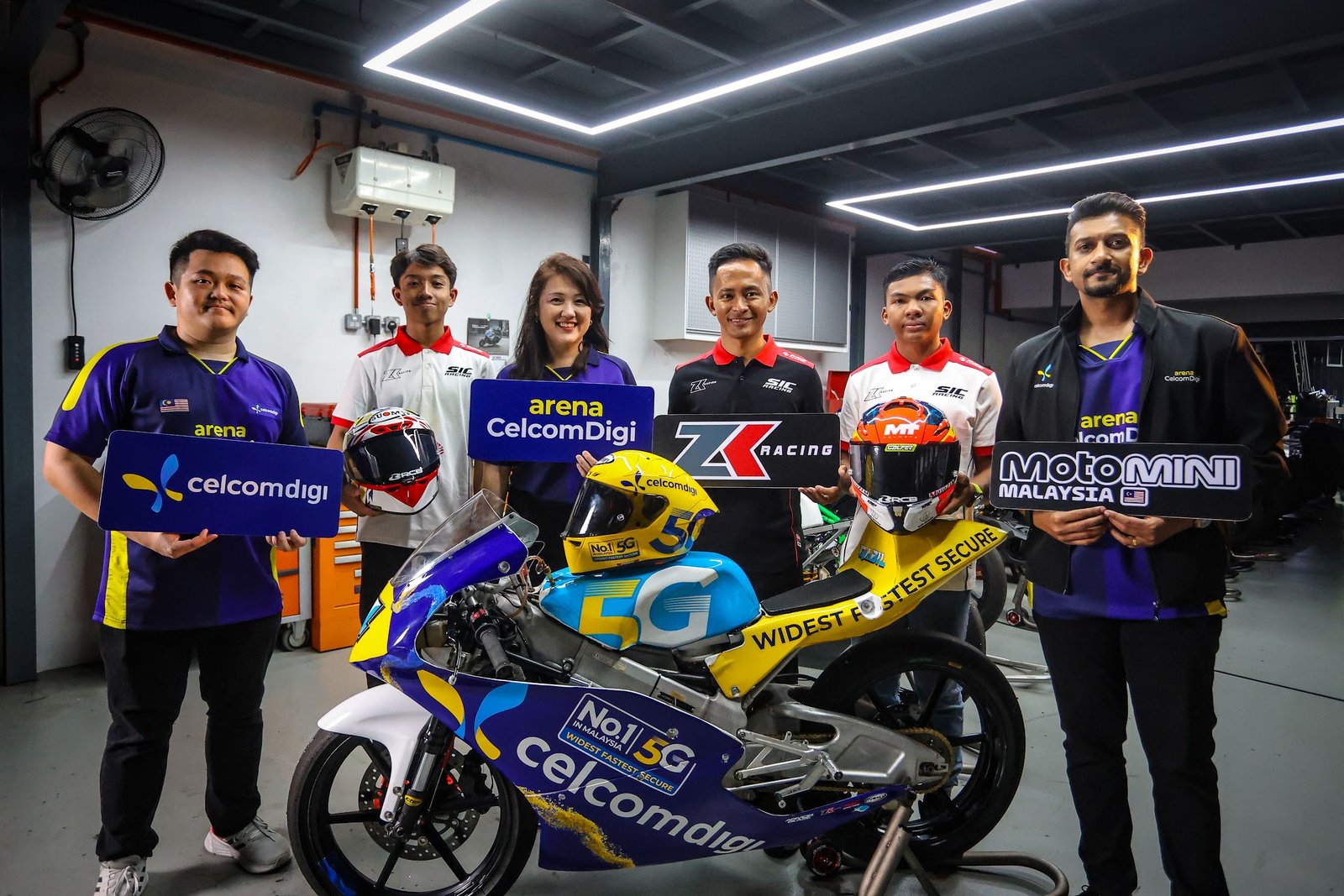
Aligned with their Arena CelcomDigi platform’s ambition to connect Malaysians through active lifestyles and sports, they have announced a partnership with Zulfahmi Khairuddin’s ZK Racing Team to back MotoMini Malaysia. And more importantly, they are putting their considerable financial muscle behind long-term development for the next generation of Malaysian motorsport talents, including ongoing support for Hakim and Qabil.
This is, quite frankly, a revelation. Here is Malaysia’s largest mobile network operator—a business connecting more than 20.3 million users, usually associated with Wi-Fi routers and network footprints—stepping up to the plate when nobody else would. They aren’t just slapping a blue and yellow sticker on a fairing and calling it a day. They are injecting actual, meaningful lifeblood into a sport that desperately needs it.
And they are starting them young. The MotoMini Malaysia programme is open to riders as young as six years old. Six! When I was six, my biggest achievement was successfully eating a piece of Lego. These kids are being taught how to hit an apex at terrifying speeds. Thanks to this partnership, two promising young riders will be identified, supported in their racing journey, and given opportunities to gain insights from Hakim and Qabil through direct mentoring sessions. It provides a proper, structured development pathway from the grassroots of Malaysia all the way to the FIM MiniGP World Final in Valencia, Spain.
It’s about time someone in the corporate sphere realized that motorsport is a goldmine of discipline, engineering, and raw, unfiltered human endeavor. CelcomDigi’s Head of Brand & Marketing Services, Chan May Ling, hit the nail on the head when she said they hope to inspire more young Malaysians to pursue their passion for motorsports and believe in how far they can go. And ZK Racing’s Director, Zulfahmi Khairuddin, finally has the corporate backing to develop a stronger pipeline of talent capable of competing with the very best on the international stage.
So, I tip my hat to CelcomDigi. In a world suffocated by red tape and risk-averse marketing executives, they have done something brave, something necessary, and something magnificent. They have recognized that true talent shouldn’t be left to wither on the vine for lack of a few quid.
Let this be a lesson to every other massive corporation out there. Put the golf clubs away. Cancel the wellness retreat. Stop funding boredom, and start funding brilliance. Because thanks to CelcomDigi, the next generation of Malaysian speed demons is coming, and I suspect they are going to be absolutely unstoppable.