I have a theory about modern life. It is that we are all being slowly, deliberately, and systematica...

Listen, I’ve spent enough time in the stands of Malaysian stadiums to know a “fixed match” when I see one. I’ve seen bureaucrats celebrate a 1-1 draw like it was a World Cup victory, but when the SPM 2025 results dropped and I saw a School Average Grade (GPS) of 0.60 for MTNP Turath and 1.06 for MTNP, my first instinct wasn’t to cheer—it was to check the referee’s bank account.
In a country where we treat mediocrity as a protected national heritage site, these numbers feel like a personal insult to every “bigwig” sitting in a plush office at the Ministry of Education. A GPS of 0.60 means the average student in that cohort is breathing the rarefied air between an A and an A+. They aren’t just passing; they are colonising the top of the bell curve while the rest of the nation is still trying to figure out which end of the pen to bite. Predictably, the keyboard warriors and the “suits” who haven’t opened a textbook since the disco era began chirping that it’s just “religious papers” inflating the grades.
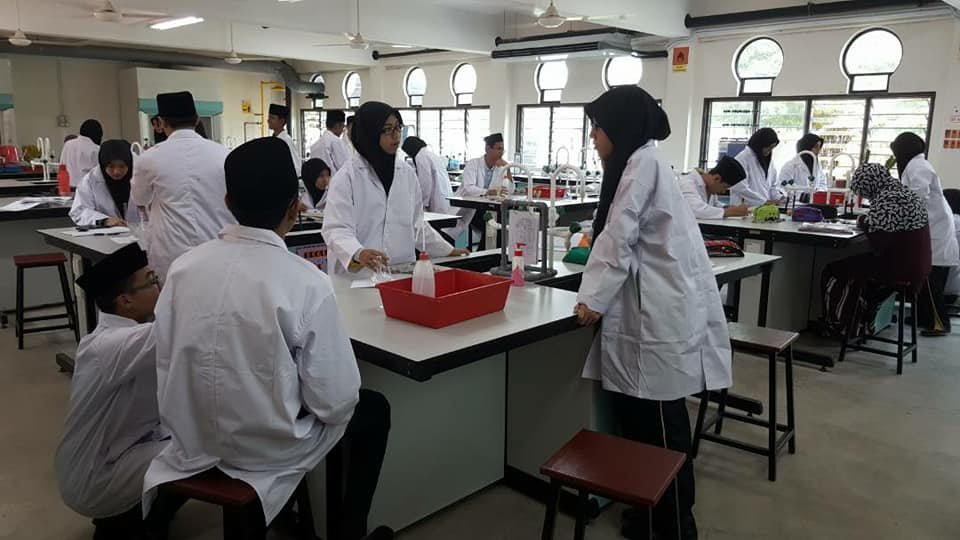
Now, let’s perform an autopsy on that particular brand of incompetence. If you think taking Al-Adab Wa Al-Balaghah is a walk in the park compared to Physics, you’ve clearly never tried to navigate the linguistic gymnastics of high-level Arabic while simultaneously solving Additional Mathematics. The critics call it grade inflation, but I call it a “Dual-Stream Burden” that would make a Premier League midfielder collapse from exhaustion. While your average Science Stream student is struggling to juggle nine subjects, these MTNP kids are playing a high-stakes game with 11 or 12. They aren’t taking the “easy route”; they are taking the scenic route through a minefield. The bureaucratic theatre ignores the actual science here: Hifz isn’t just about rote learning; it’s cognitive cross-training. When you spend your dawn hours memorising 30 juzuks of the Quran, you aren’t just storing text—you are building neural pathways and developing a level of focus that makes a three-hour Physics paper look like a casual Sunday kick-about at the padang. It’s neural plasticity on steroids.
In the world of Bahas Bola, we talk about “intensity” and lionise players who stay late at the training ground, but the daily schedule of an MTNP student makes a professional athlete’s routine look like a spa retreat. We are talking about a gruelling cycle that begins at 3:00 AM and doesn’t quit until 11:00 PM. From dawn memorisation sessions to high-level afternoon science labs, this isn’t a school—it’s a high-performance academy. It’s the academic equivalent of La Masia, but instead of producing Messis, they’re producing scholars who can derive a calculus formula and then explain the ethics of classical Islamic jurisprudence without breaking a sweat.
The skeptics—bless their cynical, unimaginative hearts—claim that Yayasan Pahang is simply “creaming” the best students. They argue that if you take the smartest kids, you get the best results. To which I say: So what? Even the best talent fails under poor management. Look at Manchester United. Having “the best” on paper means nothing if your “Architecture of Excellence” is built on sand. MTNP isn’t just a collection of smart kids; it’s a masterclass in institutional support. Yayasan Pahang provides a centralised, well-funded model that ensures these students aren’t distracted by the mundane failures of the national system. They’ve built a culture of Thabat—resilience—turning academic integrity into a point of spiritual honour. When these students sit for an exam, they aren’t just fighting for a certificate; they are defending a philosophy.
The real reason the “bigwigs” are uncomfortable with this success is that it proves a terrifying point: the system can work if you stop making excuses. MTNP has debunked the myth that religious education is the enemy of scientific progress. While the rest of the nation’s education system participates in a badly scripted drama of shifting policies and falling standards, Pahang has quietly built a factory for elite performance.
Even the “bigwigs” over at The Economist are starting to sweat, recently noting that modernisation is making South-East Asia more Islamic, not less. Their thesis is a slap in the face to every Western-educated liberal who thought “progress” meant ditching the prayer mat for a soy latte. They’ve noticed what Pahang has known for years: modernity and religiosity aren’t in a relegation battle; they’re on the same team. The “suits” in London are baffled that economic growth and internet access haven’t turned us into secular carbon copies of Brussels. At MTNP, piety has become prestigious. It’s not a retreat to the past; it’s a high-tech, high-performance upgrade of the future where the prayer hall and the science lab have a seamless tactical overlap.
So, the next time someone tells you these GPS scores are “too good to be true,” tell them to wake up at 3:00 AM and start memorising. Until then, keep your eyebrows raised at the critics, not the achievers. In the league table of Malaysian education, MTNP isn’t just at the top; they’ve already won the treble while the “suits” are still arguing over the offside rule.