I have a theory about modern life. It is that we are all being slowly, deliberately, and systematica...

The modern international football apparatus is no longer a competition between sovereign nations; it is a high-stakes, cross-border identity heist executed by people who spent their formative years arguing on internet forums. We are told to marvel at the pristine pageantry of the 2026 World Cup, to weep during the anthems, and to believe that the eleven men on the pitch represent the pure, unadulterated distillation of a single flag. In reality, national identity has become a highly fluid asset class, and international tournaments are just a massive exercise in corporate heritage-farming where the savviest digital cartels win by default.
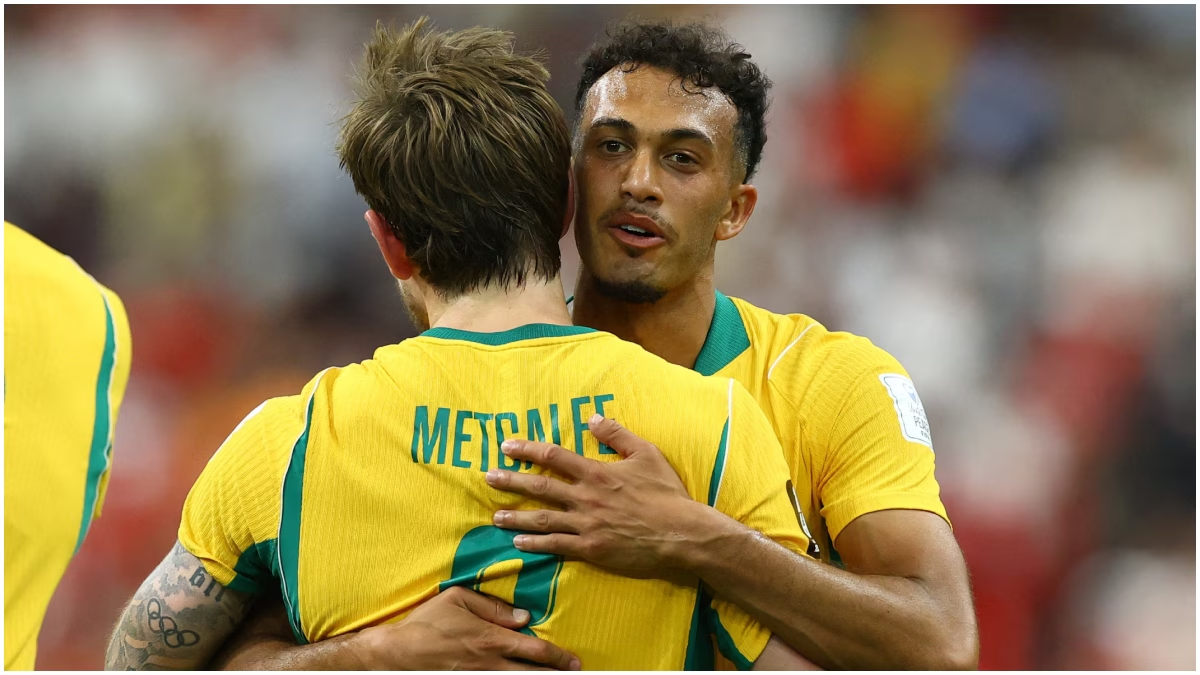
Take the collective psychological meltdown that recently transpired at Vancouver’s BC Place Stadium. Australia was busy dismantling Turkey with the sort of sterile, hyper-functional transition football that looks like it was designed by a German logistics firm. It was efficient, it was dull, and then the sixty-first minute arrived. Out stepped Nishan Velupillay, a winger born and bred in the suburbs of Melbourne, making his tournament debut. To the average bloke in the stands, it was a routine squad rotation. But across the Pacific, an entire population of football-starved digital citizens experienced a synchronised spiritual awakening. Before Velupillay’s boots could even grass the turf, the comment sections of every major football platform were utterly obliterated by a relentless swarm of Malaysian netizens typing two words of supreme, unhinged geopolitical desperation: done claim.
There is a profound, beautifully tragic comedy in this brand of internet-era cope. Malaysia’s actual national team experiences the World Cup the same way the rest of us experience a trip to Mars—as a theoretical concept viewed on a screen while consuming late-night carb-heavy street food. Yet, through the magic of a genealogical chart and a few keystrokes, a kid from Victoria suddenly became the saviour of the Klang Valley. We did not qualify for the tournament, so we simply decided to colonise the Socceroos’ team sheet via the algorithm. It is a masterclass in modern sports consumerism. If you cannot build a functioning football infrastructure, you can always just scroll through the diaspora, find someone with a recognisable surname, and declare a national holiday.
You cannot actually blame the lad for choosing the green and gold over the local alternative. To suggest that a rising talent should trade a functional, taxpayer-funded Western sports academy for the administrative circus of local sports governance is not patriotism; it is career suicide. We live in a sporting ecosystem where the bigwigs treat bureaucratic chaos not as a flaw, but as a core philosophy. This is the same glorious establishment that routinely turns basic developmental logistics into a badly scripted soap opera, where decisions are made by suits who look like they haven’t run for a bus since the late nineties. If Velupillay had committed to the ancestral homeland, his tournament preparation would not have involved high-altitude sports science. It would have involved dodging public slanging matches between federation executives, navigating endless committee meetings, and praying that the national stadium pitch had not been leased out for a corporate fertiliser expo the week before a match. There is a bittersweet “what if” whispered in local coffee shops, but deep down, everyone knows the truth. Keeping that raw talent approximately four thousand miles away from local sports politics was the only reason it survived long enough to touch the ball in Canada. Our greatest contribution to his career was our total inability to interfere with it.
But while one country celebrates a boutique, single-player digital heist, the African continent is currently witnessing the ultimate corporate outsourcing tragedy. Look closely at the squads currently dominating the groups in North America. The actual Nigerian national team is currently sitting on their living room sofas, victims of yet another agonising qualification collapse engineered by their own handlers. Yet, the tournament itself is practically powered by Nigerian DNA. Welcome to the ultimate paradox of the global game, where the best players on the planet are conquering the world while wearing the shirts of their European birth countries. You want world-class genius? You watch Bukayo Saka turning defenders inside out for England, Jamal Musiala slicing through midfields with ice-cold German precision, or Michael Olise providing the creative pulse for a glittering French side.
Nigeria has essentially become the invisible holding company of global football. They are the ultimate sports incubator, supplying the raw, brilliant code while European superpowers simply slap their own high-end logos on the finished product and claim the intellectual property. It is a magnificent, heartbreaking assembly line where the global South produces the raw genius and the global North reaps the silverware. Do not mistake this for simple theft, though. The European academies did not kidnap these players; they won them by default because the local alternative is run like an absolute train wreck. The suits in the local federations have turned institutional incompetence into a high art form, specialising in delayed flights that leave athletes sleeping on airport benches, missing bonus payments that vanish into the bureaucratic ether, and sudden coach firings executed via late-night social media threads.
Why would any sane athlete, raised in the hyper-professional environments of London, Munich, or Paris, trade structural sanity for a federation that views basic logistics as an optional luxury? The old empires did not need to seduce these players with grand patriotic speeches; they just offered them a flight that lands on time and a physio table that isn’t held together by duct tape. The traditional concept of the footballing nation-state is entirely dead, replaced by a borderless generation that carries one passport in their pockets and another in their bloodlines. So let us discard the romantic, outdated notions of sovereignty. If the world belongs to the diaspora, then the traditional hierarchy is a myth. Malaysia is technically winning by proxy, Nigeria is running away with the Golden Boot in spirit, and the traditional football superpowers do not actually own the game anymore—they are just renting the talent we were too disorganised to keep.
Done claim.