Let’s get one thing straight before the corporate lawyers at KLCC start twitching: I love the smell ...

In 1995, a little-known Belgian footballer named Jean-Marc Bosman delivered a legal bomb to the European game. It was less a gentle tap on the shoulder and more a seismic event that tore down the walls of transfer restrictions, igniting the global behemoth we know today. It was a victory for the worker, the artist, and the free market—basically, everything a bureaucrat despises.
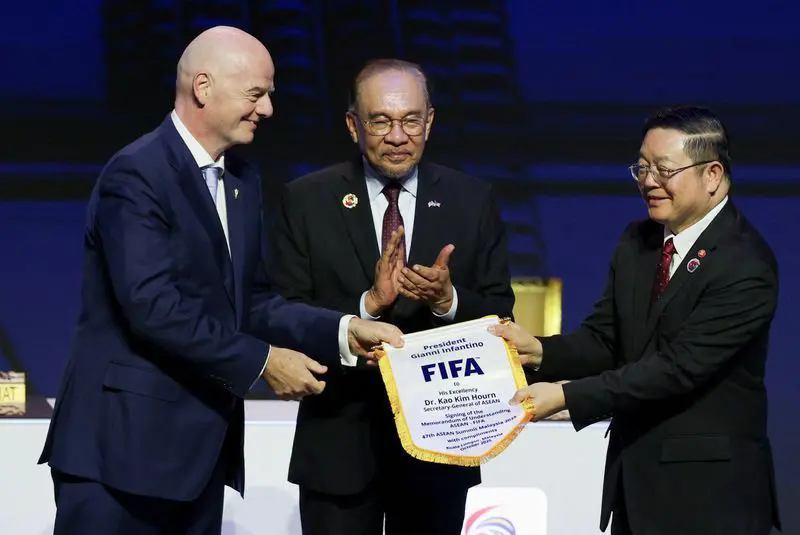
Fast forward to Kuala Lumpur, October 2025. FIFA President Gianni Infantino and ASEAN’s leaders are all smiles, signing a fresh Memorandum of Understanding (MoU) to “deepen collaboration” and launch a glitzy FIFA ASEAN Cup. They talk about unity and development. Sounds marvellous, doesn’t it? Except they spent all that political capital celebrating a new cup while completely ignoring the one policy that would truly turbocharge regional football: freeing the players.
They missed the point. It’s like buying a Formula 1 car but only being allowed to drive it on your driveway. And the culprit? The utterly nonsensical, talent-stifling foreign player quotas that treat a top Indonesian striker as less valuable than a third-tier European journeyman.
The current system is so spectacularly flawed, it could only have been conceived in a windowless room by people who think “football” is a type of stationery. The typical ASEAN quota system is a structural flaw. It locks players into national leagues that often can’t afford to pay them competitively. It creates a ceiling on quality, ensuring that no truly dominant regional force can emerge. The Thai League, the Malaysian Super League, the V. League—they all become echo chambers, unable to freely attract the best talent from their neighbours.
Imagine a brilliant guitarist from Singapore who can only play four gigs a month in Jakarta, simply because of his passport. Absurd, right? Well, that’s the economic reality facing Southeast Asian footballers. They are forced to seek careers in Japan or South Korea not because they want to, but because their own region has built an unnecessary cage of bureaucratic nationalism around their livelihoods. We just witnessed the grand signing ceremony, the perfect platform, and yet the cage remains.
The path to freedom lies not in passionate protest, but in cold, hard trade policy. Yes, you heard me. The ASEAN Professional Footballer (APF) Status, pushed through the ASEAN Economic Community’s (AEC) Mutual Recognition Arrangement (MRA) framework, is the key.
This is the ultimate policy hack: By recognising a proven, high-level ASEAN player as a ‘special category of skilled professional’—like an engineer who can actually build something, or an architect who designs something more inspiring than a concrete slab—the AEC can force an expedited, near-automatic work permit. The APF becomes a regional passport for talent. The AFF defines the rigid criteria (and it better be rigid, none of this “participated in a local carnival” nonsense; think 20 national team caps, or a current AFC Pro Licence), and the AEC guarantees the streamlined visa process. It replaces complex, country-specific immigration red tape with a single, clear, region-wide handshake of professionalism. It’s the bureaucratic equivalent of upgrading from dial-up internet to fibre optic—finally, something that actually works!
This isn’t some pie-in-the-sky dream. Malaysia, as ASEAN Chair in 2025, holds the political microphone. This is their final opportunity to prove they’re not just great hosts for summits, but genuine visionaries willing to drive real economic change through the soft power of sport. The ASEAN Football Federation (AFF) needs to stop politely asking and start demanding that the AEC recognises this proposal.
If Malaysia’s leaders get a short, sharp commitment to the APF into the Chairman’s Statement at the year-end summit, they create a political mandate that no immigration office can ignore.
The payoff? A vibrant, cross-cultural league system, better TV deals, stronger club brands, and ultimately, national teams that can finally compete on the global stage. It’s about building a common market not just for goods, but for dreams.
So, let’s stop celebrating new cups and start tearing down old walls. Let Malaysia, the AFF, and the AEC finally drop the Bosman Bomb. Because frankly, anything less is just plain boring. And nobody wants to be boring.